All of this debate leaves energy mills watching the political panorama, and awaiting key choices on local weather coverage
Article content material
How a lot will it value Albertans to maneuver to a net-zero energy grid by 2035?
Commercial 2

Article content material
It’s a good query a couple of advanced situation.

Article content material
The brief reply, if we’re all being completely trustworthy, is that nobody actually is aware of as a result of key particulars nonetheless have to be labored out.
But, for a province that depends on pure gasoline to generate a number of electrical energy — even with an funding bonanza streaming into renewables — it’s going to return with prices to fulfill the federal goal inside a dozen years.
And it’s going to wish some flexibility to make all of it occur.
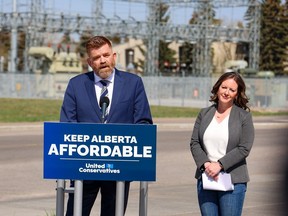
In accordance with the UCP, the value for Alberta will probably be sky excessive, with the celebration saying Wednesday the prices to the provincial financial system and shoppers would hit at the very least $87 billion, though it quickly confronted pushback on that quantity by the consultants it employed to evaluate the general financial impact.
Its assertion was primarily based on a report from the Alberta Electrical System Operator (AESO) final summer season — it pegged the prices of reaching net-zero by 2035 within the energy sector between $44 billion to $52 billion — together with a brand new research the UCP commissioned by Navius Analysis.
The celebration launched its report whereas stating NDP Chief Rachel Notley beforehand dedicated to hitting the net-zero goal by 2035, calling it the “most costly promise in Alberta political historical past.”
Article content material
Commercial 3
Article content material
The UCP employed B.C.-based Navius to have a look at the impression of reaching net-zero in Alberta’s energy sector on the provincial financial system.
It concludes the federal Clear Electrical energy Laws (CER) would have a cumulative impact on the provincial gross home product (GDP) of about $35 billion by 2040.
“Unbiased evaluation says that even when this may be performed, it would value Albertans and the Alberta financial system at the very least $87 billion,” UCP candidate Brian Jean instructed reporters Wednesday, including the 2 figures collectively.
Sure, that may be a number of loot, if true.
-

Alberta Election 2023 stay: Could 4 updates
-

Notley, Smith pitch swing voters in Calgary marketing campaign stops
-
David Staples: Your rising energy payments may nicely outline the result of the Alberta election
-

AESO report outlines prices, challenges to reaching net-zero energy grid by 2035
However by the top of the day, Navius put out a string of tweets saying it wanted to “set the record straight.”
“It’s necessary to acknowledge that lowering emissions will possible come at a value,” it mentioned.
“This $35 billion already accounts for, and isn’t additive to, the funding estimated within the AESO report. The associated fee to Alberta’s financial system reported within the media in the present day is greater than double what our mannequin suggests it is going to be.”
Commercial 4
Article content material
Ignoring the very fact it was the UCP utilizing these figures, some specialists aren’t satisfied concerning the AESO figures, both.
“I don’t put a lot credence in them,” electrical energy knowledgeable Blake Shaffer, an economist on the College of Calgary, mentioned Wednesday.
He identified the AESO report used assumptions for wind and photo voltaic costs which are far larger than what {the marketplace} is now seeing.
On the marketing campaign path, Notley dismissed the UCP’s assault.
“The research that they’re basing their numbers on fails to consider the alternatives that come from technological innovation, alternatives that trade themselves are saying that they will use,” she mentioned.

It’s price stating that wind and photo voltaic funding is rising quickly in Alberta. But, utilizing pure gasoline to generate electrical energy — creating greenhouse gasoline emissions within the course of — is essential.
On the finish of 2022, purely gas-fired era made up about 60 per cent of the province’s put in era capability, whereas renewable era was 31 per cent, roughly double the degrees since 2018, in line with AESO.
Commercial 5
Article content material
And as anybody who opens a utility invoice is aware of, energy costs have been heading up over current years, making it a delicate political situation.
The Navius report has loads of cautionary notes and assumptions that it needed to make within the numerous situations it examined.
To be truthful, some areas — together with the main points of the incoming federal Clear Electrical energy Laws (CER) — aren’t sure but.
Within the research, Navius discovered emissions will, naturally sufficient, fall when the CER is adopted, whereas the financial system grows by a decrease charge, resulting in a cumulative impact on GDP of about $35 billion over a two-decade span.
In a press release, Brianne Riehl of Navius mentioned the impact on Alberta’s financial system depends on AESO’s estimates of funding ranges wanted to succeed in net-zero emissions.
“The $35-billion GDP impression accounts for each the prices and advantages of this funding,” she wrote.
“Due to this, the $87 billion determine being communicated publicly . . . just isn’t a good illustration of the prices of the coverage.”
On Thursday, UCP Chief Danielle Smith wasn’t backing down, nor was Notley.
“We don’t have to situation a correction . . . We had been quoting two totally different reviews,” Smith mentioned. “So the 2 collectively come to $87 billion.”
Commercial 6
Article content material
In Calgary, Notley mentioned attending to net-zero by 2035 is a chance for rising Alberta’s financial system and creating jobs, and it is going to be “a internet acquire” for financial progress.
“We’ve obtained Danielle Smith on the market refusing to disavow what’s, on the very least, a $40-billion piece of misinformation,” she mentioned.
Jean mentioned his authorities would transfer to get to net-zero within the energy system by 2050, however couldn’t say what the prices could be for the province.
Duane Reid-Carlson, chief government of Alberta-based electrical energy consultancy EDC Associates, mentioned his agency accomplished its personal research on the difficulty final yr and located the prices had been much like what AESO’s research concluded.
“There’s a number of interpretations throughout all of those totally different numbers,” he mentioned. “The salient level is they’re all within the tens of billions of {dollars}.”
All of this debate leaves energy mills watching the political panorama, and awaiting key choices on local weather coverage.
Capital Energy CEO Brian Vaasjo, one of many province’s largest energy mills, mentioned Alberta might have to make use of offsets to succeed in the net-zero 2035 goal and he’s not “seen or heard of any situations the place Alberta can transfer ahead with out pure gasoline” utilized in 2035 and past.
“Relying on the coverage path, if it’s fallacious or poor coverage path, you’ll both have lights going out, emissions that would have in any other case been prevented not being (prevented), or have very excessive prices,” he added.
“In a province like Alberta, you’ll be able to’t simply hope away prices or hope away emissions.”
Chris Varcoe is a Calgary Herald columnist.
Feedback
Postmedia is dedicated to sustaining a full of life however civil discussion board for dialogue and encourage all readers to share their views on our articles. Feedback might take as much as an hour for moderation earlier than showing on the location. We ask you to maintain your feedback related and respectful. We have now enabled electronic mail notifications—you’ll now obtain an electronic mail should you obtain a reply to your remark, there may be an replace to a remark thread you observe or if a consumer you observe feedback. Go to our Neighborhood Tips for extra data and particulars on the best way to modify your electronic mail settings.
Be part of the Dialog